
about
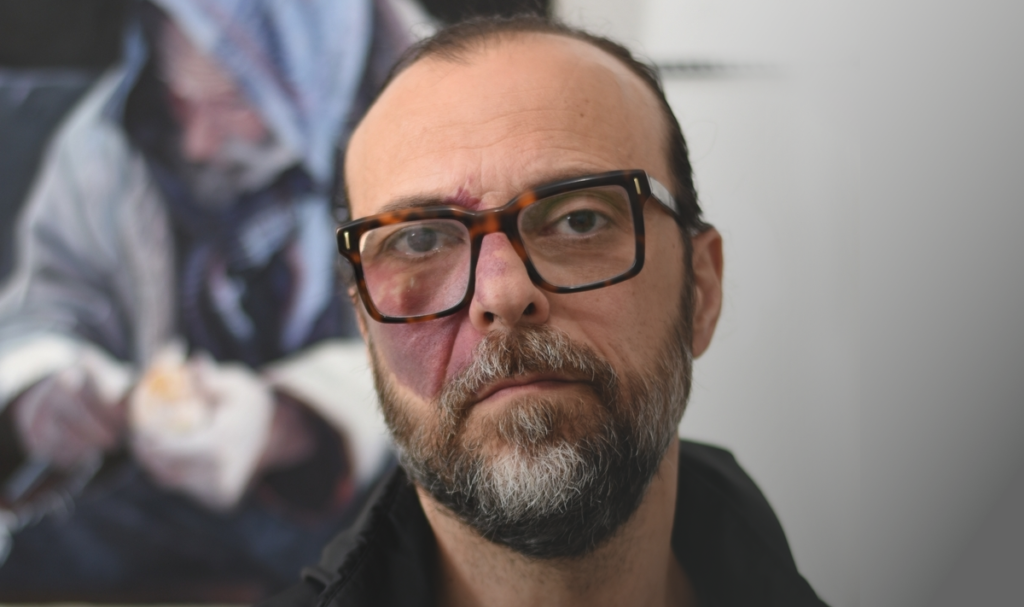
From Logos to Layer: The Plastic Gesture between Glazing and Mezzotint
I am Khalil Ibrahim, a Lebanese writer, painter and printmaker.
The Word:
“In the beginning was the Word, and the Word was with God, and the Word was God.” (John 1:1)
For obvious reasons, visual artists and art historians have long disputed the rule of the “Word” over imagery. One could argue that in a dissociative state—that is, isolated from the rest of consciousness—the need for distinctions and classifications is necessary. By contrast, the opposite could be argued when you find yourself accessible to a flow that emanates and springs from a place prior to the dissociation. From early on, this has been a privilege of my consciousness and artistic awareness. Words and sights associate themselves to other senses, such as smell, and are given and restored in a unified synergy.
Material Objectification:
My artistic practice seeks to objectify the impalpable, to transform the melancholy of the human experience into a tangible substance—an incarnation. Two complementary media are mobilized: glaze painting and mezzotint. Both operate through superposition and sedimentation, in the manner of memory.
Glaze painting: thickness of time and transparency
Glazing is a pictorial technique consisting of superimposing translucent layers of paint. Each layer alters the perception of the previous ones, creating optical depth and an internal vibration. I use this technique to make perceptible what I call “the thickness of memorial time.” A memorable “muted yellow” of my childhood is never applied in a single gesture; it is the result of dozens of glazes, where grey, ochre, and light rise through strata. The painting thus becomes a palimpsest: what is visible on the surface carries within it the traces of what has been covered over, like buried memories in the reflux of memory.
Mezzotint: from darkness toward light
Mezzotint (or “black manner”) is the only printmaking technique that proceeds from black toward light. One begins by rendering the copper plate entirely rough (using a rocker), which produces a velvety black. Light is then “extracted” through polishing and scraping. This gesture is the exact plastic analogue of the tunnel-of-memory experience: the shadow-child does not seek to add light to a bright space; he reveals a clarity that was already present beneath the darkness of the memories.
Complementarity of the two media
Where mezzotint proceeds by removal (scraping) to bring forth light, glazing proceeds by addition (superposition) to construct depth. These two gestures—taking away and adding—correspond to the two movements of memory: forgetting, which hollows out, and remembering, which accumulates. In the final installation, the glazed canvases and mezzotint prints will enter into dialogue, offering the viewer a synesthetic experience of lived temporality.
Back-and-forth between theory, writing, and practice
My studio functions as a laboratory. After reading and writing, I return to the canvas or the plate to test a hypothesis: can light be a physical vibration underlying a spiritual activity? Can black be a presence rather than an absence? How can the “muted yellow” be made visible through thirty layers of glaze? How can hyperrealism be elevated to the level of total dazzlement, restoring the incarnation of the experience?